![]() |
| We never get tired of looking over the grand style of French designer Catherine Alhinc who creates hats and head wear like no one else in the world. When you check out her site, be sure to visit her stunning gown galleries as well . . . . |
MORE HEAD CHIC FROM FRANCE
THE SUIT OPTION
The classic suit is becoming a stylish alternative to the wedding gown for some brides. Like the sheath it's long and columnar only in two-pieces with a jacket and straight skirt. There are of course exceptions. Skirt shapes can be flared like A-lines or take on full bell contours even under man-tailored jackets. Pantsuits are another option with pant legs varying from slim cigarette widths to wide culotte cuts.
GETTING ONBOARD: TRAINS AND BUSTLES
A gown with a train suggests formality; typically the longer the train, the more formal the gown. So what is a train exactly? A train is that extension in the back of the skirt that follows when you move. There are two types of trains: built-in and detachable. Built-ins are integrated in the actual skirt pattern when the dress is made. These are the kind that are pulled up and bustled after the ceremony. A detachable train is a separate component, not integrated in the skirt pattern. Detachables are usually removed after the ceremony, although I’ve seen them bustled every so often when brides want to keep that bustled look going for the party.
Bustling defined is the gathering and tacking up of the train so that the bride can move around freely post ceremony. Once a gown is bustled it goes through a kind of metamorphosis as does the bride in it. There are two kinds of bustling techniques: overbustles and underbustles (French). Usually, bustling is secured with hooks and/or ribbons (narrow strips of grosgrain). Over bustling is the easiest and consists of picking up and tacking the skirt to the waist for chapel and cathedral lengths; or behind the knee for sweeps. Underbustling goes the other way—down and under, fastening to points on the under slip. Longer trains can take a combination of both over and under bustling all at once and the results can be stunning. Additional or custom bustling is done after the bodice fitting is completed. How many (more) bustle points you chose is up to you and the estimation of your alterations person. Keep in mind not every dress bustles well. Examples include ball gowns with skirts in lightweight layers like tulle or organza. The amount of layered skirts present problems. The bustling is done layer by layer which is time consuming and expensive, and you’d have to absolutely love the result to go through all that hassle. Also some gowns with sweep trains, godets or fishtails don’t bustle well. Overall, most dresses do bustle beautifully and are a joy to wear. A bustled train remains one of the most elegant and romantic elements of the wedding gown . . . .
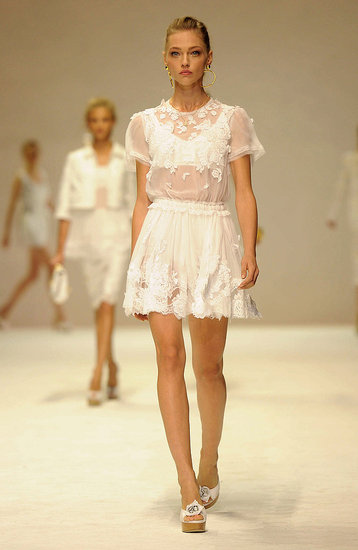
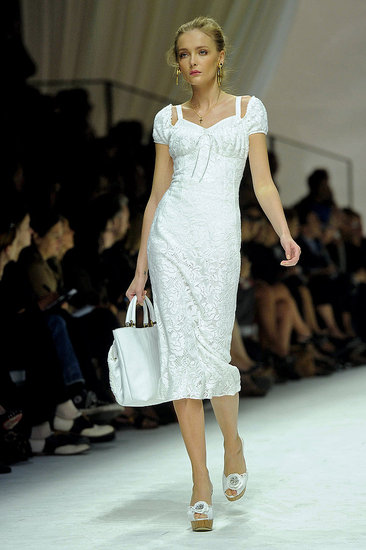
DOLCE AND GABBANA: SPRING 2011
As I'm just about ready to bring out the sweaters and leggings in anticipation of chillier days, in the fashion world Spring 2011 is all abloom. Dolce and Gabbana have gone practically all white this season, a real boon for brides who like the sheer look of chiffon and lace. Ever youthful, white is clean and works in just about any wardrobe. Check out the leopard print . . . uber- chic whether worn in the winter or spring . . .
Photos courtesy of Fashionologie
GIRLIE GLAM
Okay, okay, okay, I know I've posted boards of bold black stripes, silhouettes, cameos and pink monocromatics before (recently if I remember correctly)--but I just can't sing enough praises of this clean and daring combo. If you're looking toward a Spring 2011 wedding, this might just be your inspiration. Many thanks again to Anita Brown over at SMP Style Circle. I'm always lifting her boards and sharing her talent with you. Do visit her blog 2bsquared Design chock full of ideas on paper, photography and fashion.
VINTAGE CARNIVAL
| Here's a truly whimsical set of images put together by Shana over at SMP's Style Circle. For me, the vintage 50s dress, yellow flowers and antique carousel evoke thoughts of youth and joy. Want some more inspiration? Chek out Shana's blog, Baubles and Bubbles, a place where you'll find everything to do with weddings and wedding planning . . . |
PHOTO OF THE WEEK
O Mistress Mine
O Mistress mine, where are you roaming?
O, stay and hear; your true love's coming,
That can sing both high and low:
Trip no further, pretty sweeting;
Journeys end in lovers meeting,
Every wise man's son doth know.
What is love? 'Tis not hereafter;
Present mirth hath present laughter;
What's to come is still unsure:
In delay there lies not plenty;
Then, come kiss me, sweet and twenty,
Youth's a stuff will not endure. --William Shakespeare--
Subscribe to:
Posts (Atom)